I had the chance to be a “survivor” of a mock disaster for the Sacramento Metro Fire Station 21 CERT Basic class disaster simulation today. This normally means having a severe injury and role-playing an often uncooperative survivor.
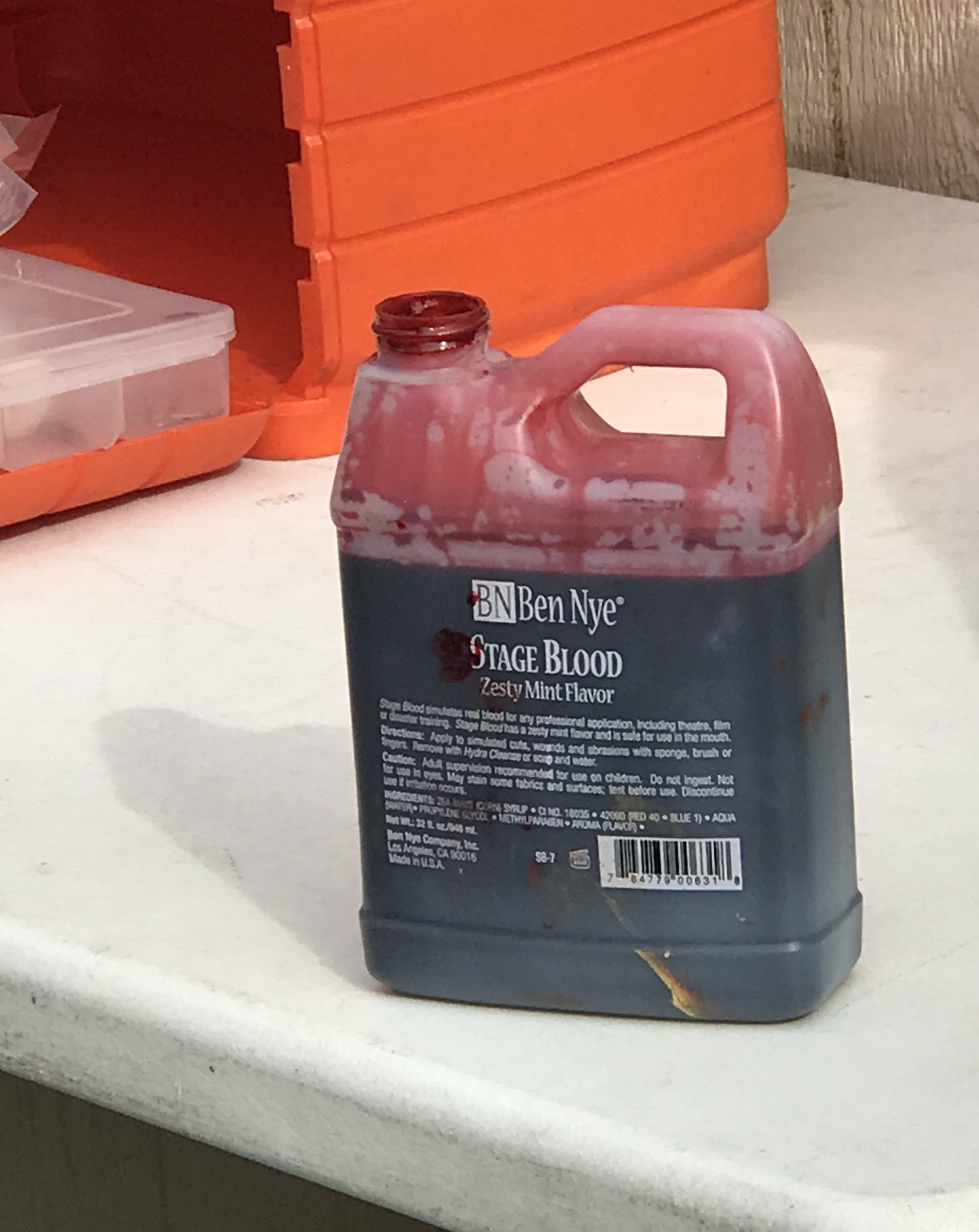
Stage blood for the CERT exercise, mint flavor.
I was to be a victim who had a big hit to the head, and was disoriented and wandering. This meant I did not get to be covered in blood, but only sported a large bruise on my forehead. Maybe I should have chosen to have more contusions on my face or something, would have been far messier. Our disaster event was we were survivors along the debris path of a plane crash. Other volunteers got to have a full makeup session of blood and gashes, one person even had a piece of glass sticking out of her head. CERT volunteers like to make it very realistic.
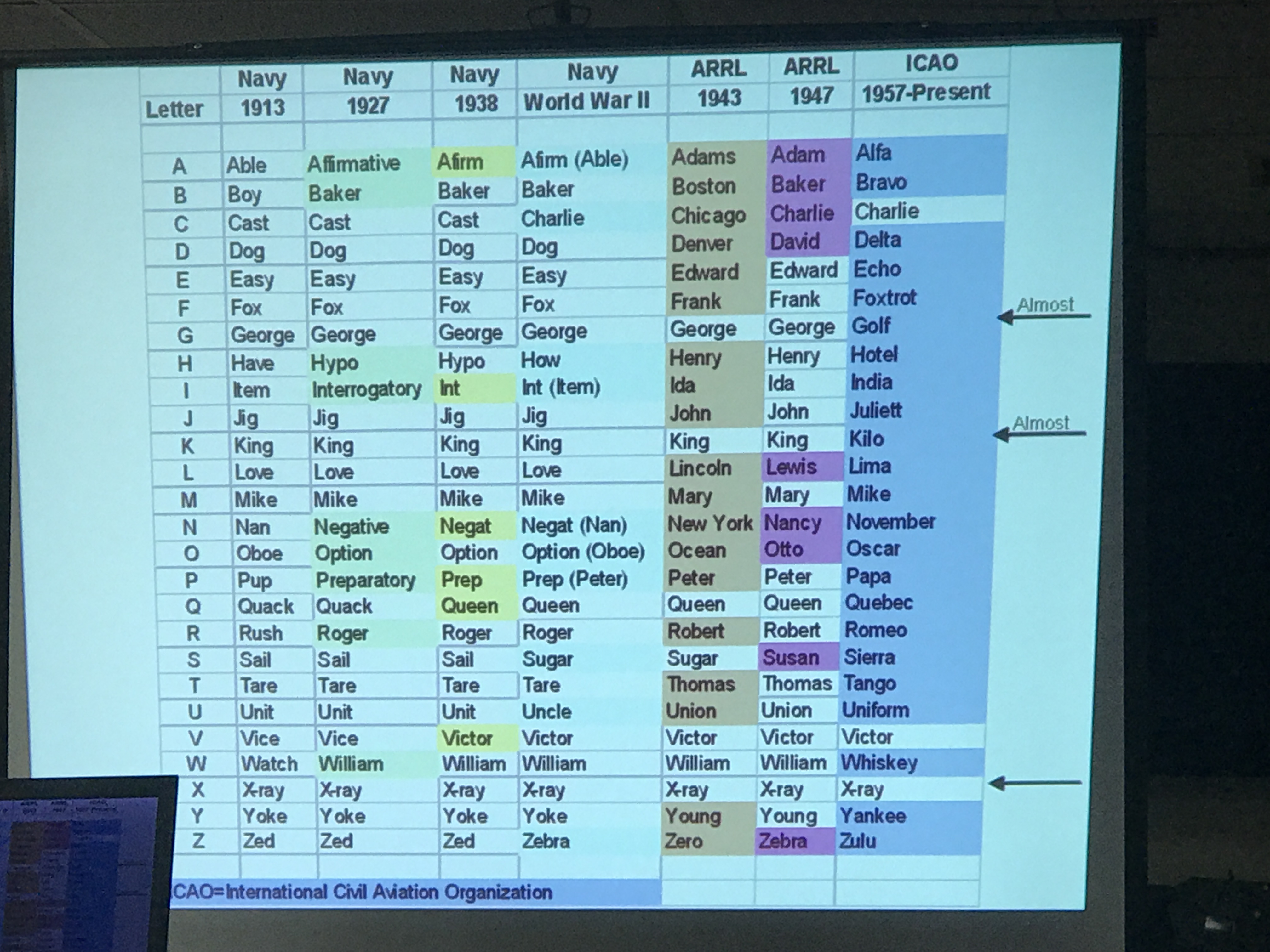
We had our monthly meeting for the Stockton Delta Amateur Radio Club on February 8, 2018 at 7:30pm. After usual club announcement and business, we were treated to a presentation by Jim WB6BET of the Lodi Amateur Radio Club (LARC): The History of Phonetics.
Phonetics in America from 1913 to present
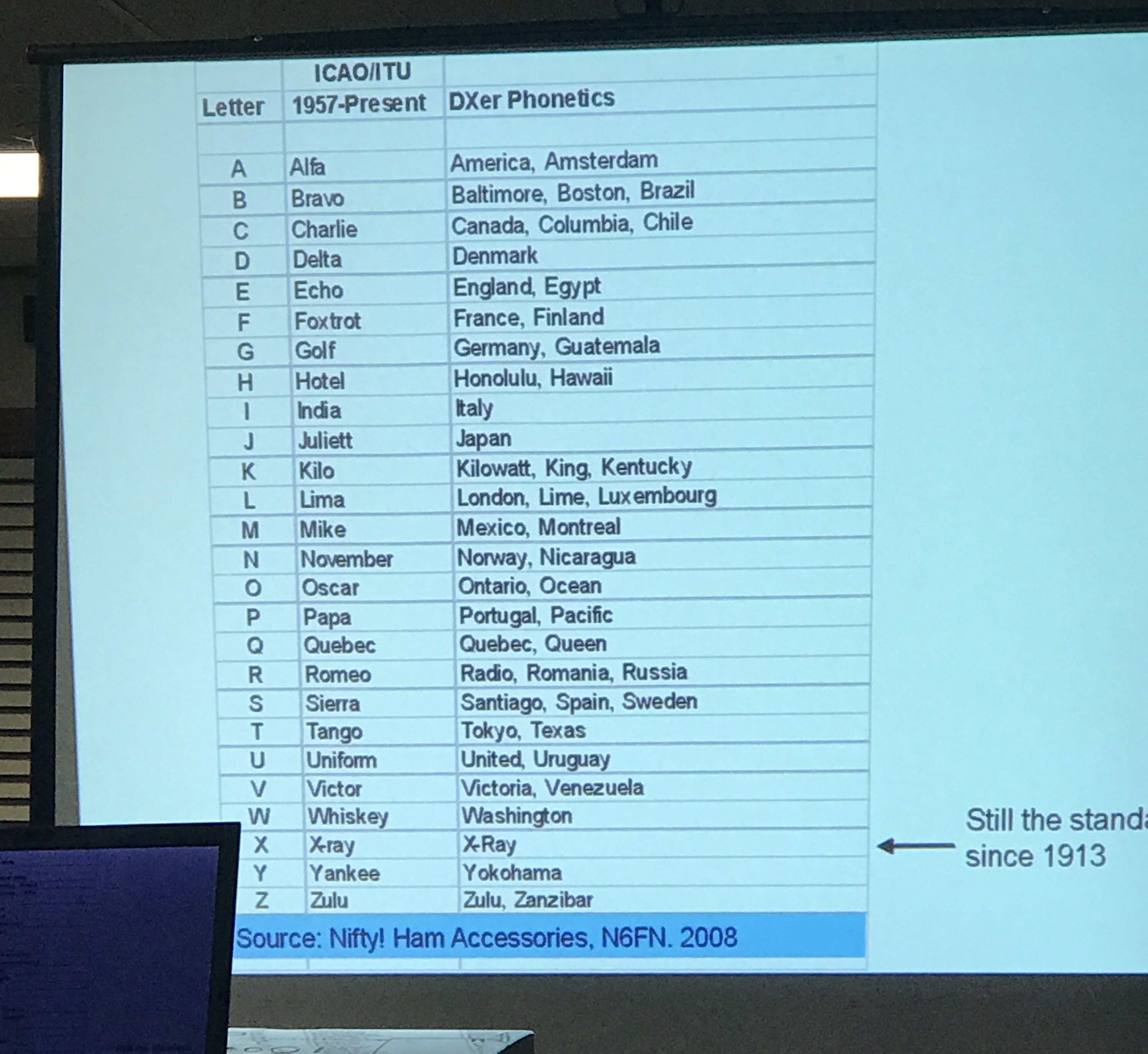
Jim went on to describe DX phonetics.
Alternative phonetics for DX, easier to read at times.
Emilia KI6YYT, president of LARC, also gave a presentation on the USS Hornet, describing its radio systems and an all-women’s QSO event they held there last year. It was interesting to see the kinds of radios they used on ships back then (one slide had a bank of Harris RF-350s). It’s cool that the club meetings are not only a chance to place faces with callsigns, but that each one has some educational aspect in mind. SDARC really has a goal of helping the ham community learn more and make an impact.
Today marks the day I took the final for ARRL’s EC-001: Emergency Communications Basic/Level 1 course. It’s a 9 week course that I started in November and covers a wide range of EMCOMM topics: From the organizational structure of emergency communicator groups to traffic net etiquette to digital modes to message handling to deployment preparation and expectations. It is designed for those who want to volunteer in ARES or another emergency communications group.
If you’re at all into antennas aside from your handheld rubber duck antenna, you should try to get an antenna analyzer. Here I am using a RigExpert AA-600: https://youtu.be/cNzKpTXH5Ak Before using this device, I would just go by the radio’s SWR reading (a poor display of SWR “bars”) to determine if I was close to resonance. The quad-band vertical antenna I have supposedly works with 10m, 6m, 2m, and 40cm. I never had much success with adjusting the end tip of the antenna for 10m until I started evaluating readings using the AA-600. My target frequency was 28.400 MHz for the LARC weekly 10m net, and 28.457 MHz for the SDARC weekly 10m net. Both frequencies had such high SWR that I could never get out very far. Turns out I was lengthening/shortening the adjustment the opposite way I thought, so no wonder I had no success. I also found that the counterpoise placement has a huge effect on SWR readings, it’s very finicky.
I found a load of RTTY on 80m band on Sunday night (1/7/2018). I tuned to 3580 kHz and found a particularly strong signal, so I hooked up my USB soundcard to my laptop, fired up fldigi and made attempts to reply, but I guess my QRP setup didn’t get heard in all the pileup chatter. Turns out, January 6-7 was “ARRL RTTY Roundup”, a nationwide contest to make contacts in the digital format, so it was easy to catch the conversations on almost all HF bands. I found the CQ’s in this format a bit odd, and didn’t really know how to format my responses or how to call CQ myself. I saw things like: TEST N6JJ N6JJ CQ (not real callsign), or CQ RU N6JK CQ. What? I went with the way I new how to call CQ, which was: CQ CQ DE AD6DM PSE K. (meaning: Calling any station from AD6DM please reply). No replies. There were a lot of transmissions like: W7KJ N6JK 599 5NN TU 73. I took these to mean an acknowledgement, a signal report, thank you, best regards. RTTY is a very quick format. It’s like a drive-by greeting that is over before you know it. It’s probably how hams did contest contact-gathering before the more modern semi-automated FT8 format. In any case, I want to get out there on RTTY and give it more of a try.
Why the new callsign? I wanted something easier to transmit in Morse code. But also, the initials make it a true “vanity” callsign. Truth be told, I applied for a 2x1 callsign and AD6DM was my second choice. But I got beat by a club for that shorter callsign. Those 2x1’s are really in demand! The migration to this new website domain is complete. The old site kf6ujs.net will remain for posterity while this site continues and grows as I do as a ham. Thank you for visiting!
Merry Christmas! Today I landed upon a video by KJ4YZI Eric of HamRadioConcepts (https://youtu.be/Jls-PiR-dBI) entitled “How I learned Morse code fast and easy”. I found the title suspect because CW is neither fast nor easy, but he did help me a lot with this simple video. He learned with the help of an Android app called Morse CT that allows him to practice by tapping the alphabet and numbers on his phone. It never occurred to me that I could tap on my phone screen to learn sending. I have been so slow going because the Koch method is tedious and very hard in the beginning. I was thinking I needed to bring my key to work, and practice using it in the off hours. I started researching practice code oscillators to connect with my key, and that was looking prohibitively pricey for the purpose. There simply isn’t a prebuilt little box that hooks up to your key and outputs to headphones for private CW practice. So seeing Eric’s video, I looked for an iOS equivalent app, and found Morse-it by Pacolabs. Now I can say, within a day I know how to send CW at around 12wpm. The app tests different aspects of CW: Tap out a series of random letters, or listen to CW and translate. Within an hour I was hitting spot-on in the composition. But half a day and I’m still about 25% on the copying from listening. There’s truth to the comments in the video: You need to learn by listening. That’s the hard part. Before today, while learning via the Koch Method, I was at around 10 letters of the alphabet listening at 17wpm. This little app was a boost of encouragement by helping me to learn the full alphabet in a short period of time, but I still cannot read as quickly as I need to… not even close. I can now talk to people, albeit slowly, but copying them will still be a challenge. So I can say that CW is neither fast nor easy. But using Eric’s method is a great boost in just slogging through the Koch Method. At least now I can actually reply to people, even if I don’t understand their full message yet.
I checked in to W6VVR Vaca Valley Radio Club net this evening and they said post-net they’d be hopping on to 7.190MHz. Quickly set up my bugcatcher for 40m and listened, but nothing heard, except for a QSO in progress on 7.192 from Arizona to Los Angeles. So I thought I’d tune around on the new Extra sections of 7.075-7.100MHz (Hawaii and Alaska can use this for voice, but we mainlanders can’t.) Was expecting CW and perhaps some blurty digital sounds. Instead I found this: https://youtu.be/mvkWdpZFwPQ What is this? I imagine it’s a digital mode (somewhat like Olivia) but I’ve never heard anything like it. Makes me think of a harmonic alien transmission.
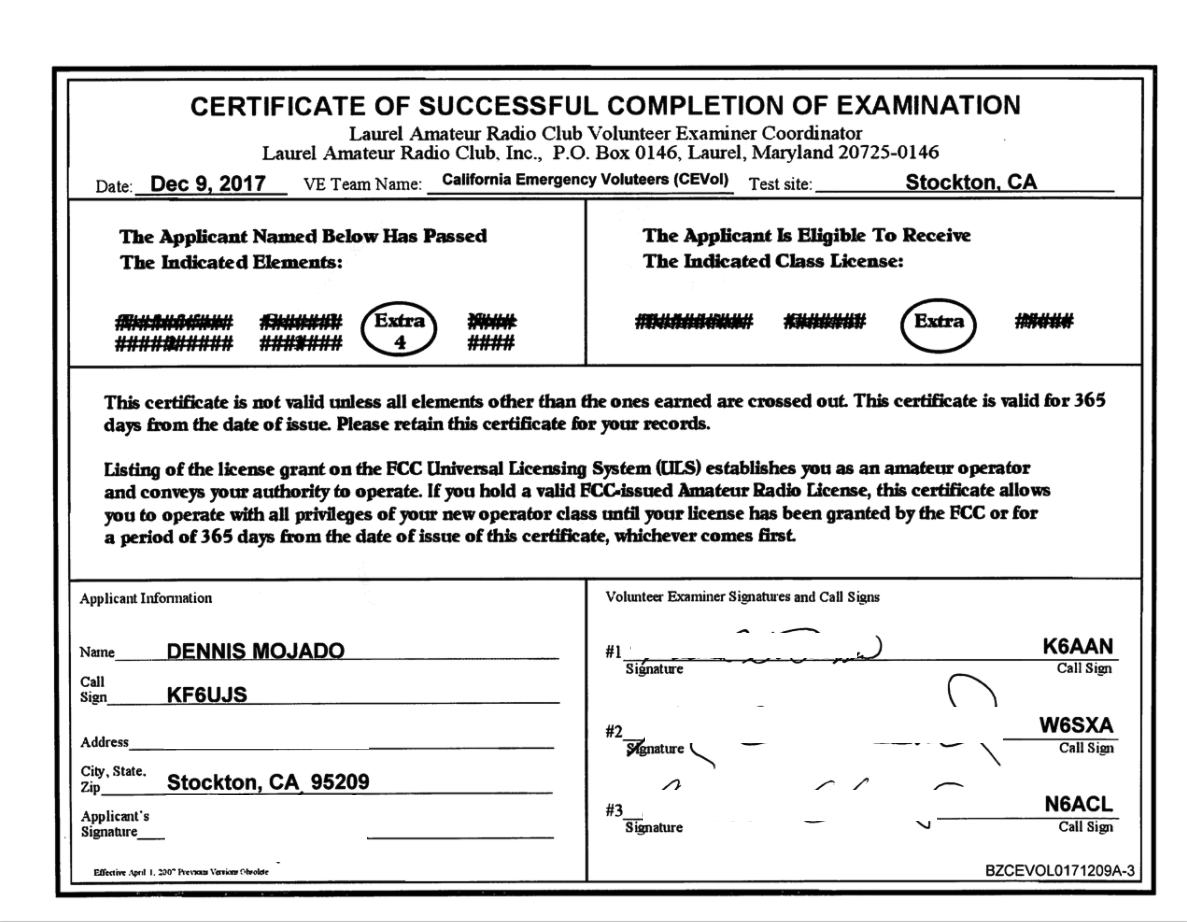
I highly recommend taking your amateur license exam with SDARC. They don't follow all those outdated 1980's ways of doing ham things (i.e. physically mailing a big stack of paper to the VEC), but file with the VEC/FCC electronically. The VE assures me I'll see the FCC database update in 3 days; instead of weeks with other examiners.
This is the last level of amateur radio licensing. Now I have no excuses… I need to just focus on actual radio practice and experimenting with all the different things that have opened up at this level. I will have the ARRL Band Plan on hand at all times till I memorize it, and can now pretty much transmit on all available FCC amateur bands without worrying if I’m in the wrong operator allocation. N6KZW Paul was there, not in a VE role, but helping out. He asked me, “What are you going to do in ham radio?” I said, “Just get out there and reach people.” I actually don’t know what I want to do next… There’s still so much to learn, and to even get working (e.g. my HF antenna mounting, digital, learn CW…). What will I do in ham radio? My problem is I want to do it all, with never the time or finances to follow each path in depth. This constraint drives selectiveness and getting creative. This was a huge rush for me, and I’d personally like to thank W6SXA Mark for study tips earlier this month; NZ6Q John for leading the HamCram and the Club (he’s got ideas and is moving the whole ham community!); K6AAN Mike for being a VE and reigniting some interest in homebrew DMR repeaters, N6KZW Paul for always being a warm helpful jokester, N6TCE Bob and N6ZDH Dan for doing a bunch of legwork and setup for the exam. Now to get on the air.
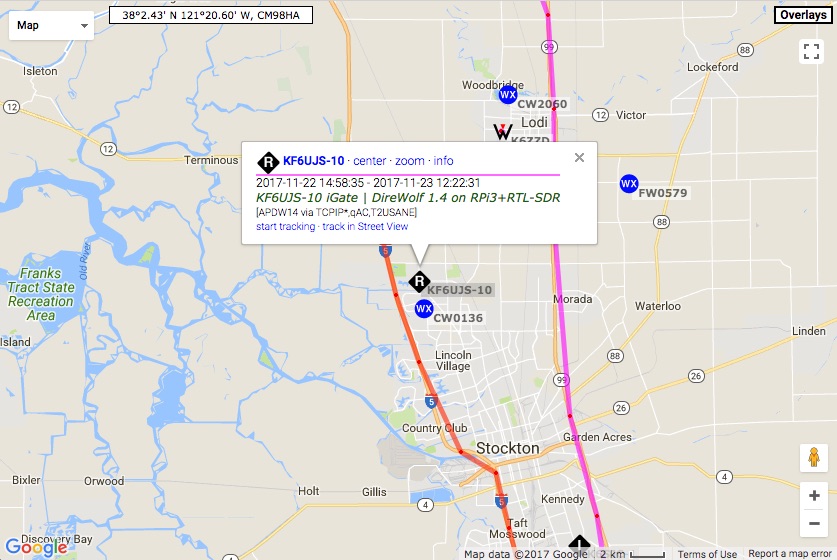
Last night I set up an Automatic Packet Reporting System (APRS)iGate to listen on 144.390 MHz for packets and report them to APRS Internet Service (APRS-IS). This is like a listening station that will improve my area APRS coverage.
My receive-only APRS station on https://aprs.fi
This can be done relatively inexpensively with a Raspberry Pi ($35), a RTL-SDR receiver ($26), and some opensource linux software available online. The latest RTL-SDR v3 is a capable little Software Defined Radio (SDR) receiver that can even receive to HF frequencies. For much cheaper than a standalone HF receiver, you can get the kit that includes a whip dipole, extension SMA cables, and mounting hardware. I lengthened the whips to 2m resonance (~19 inches each side). Using software in linux: rtl_fm and direwolf, one is able to listen for APRS traffic on 144.390 MHz, decode it, and with the Raspberry Pi connected to the Internet, can send what it hears to the main APRS servers for visibility on aprs.fi.