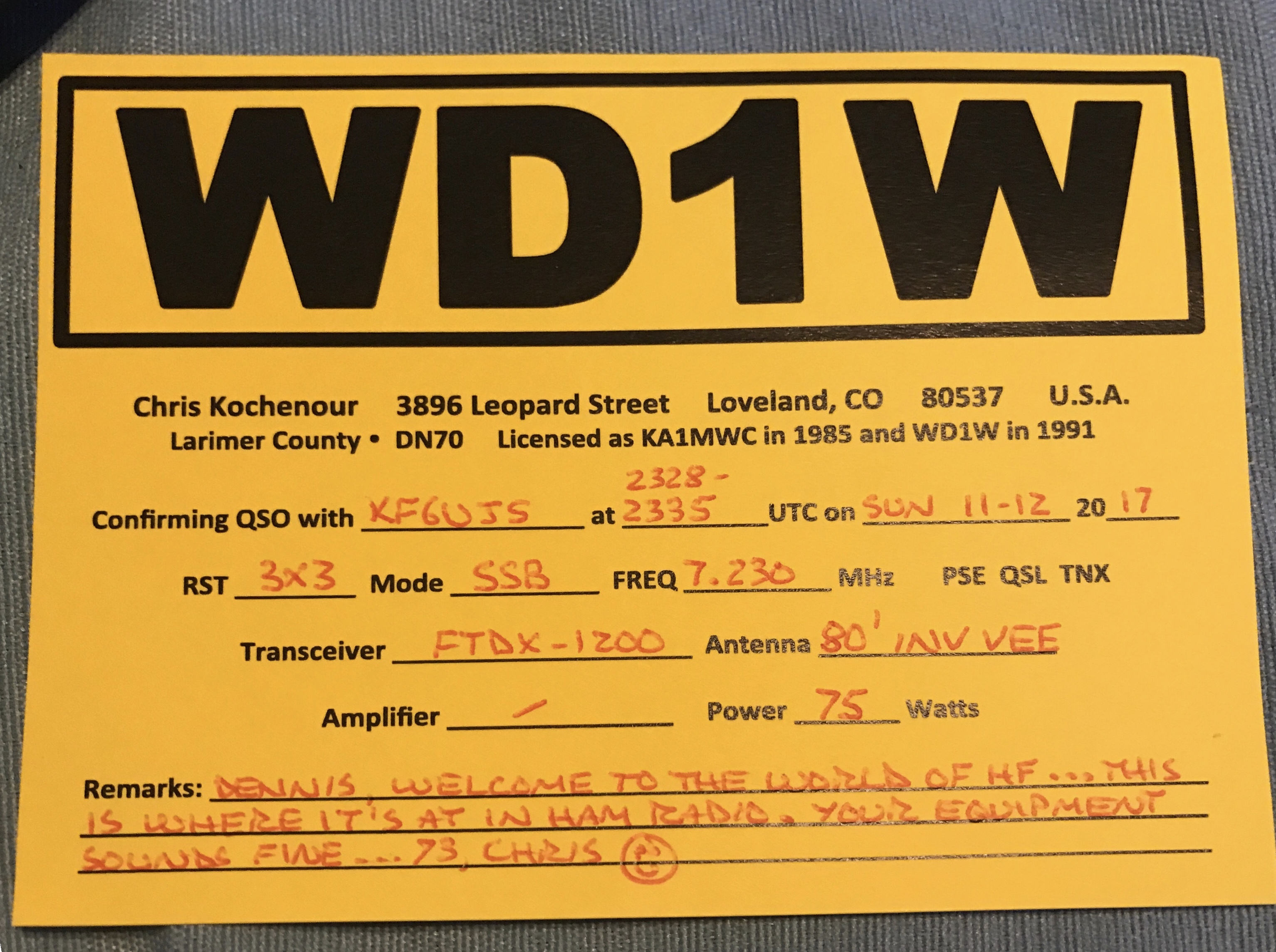
Senator Diane Feinstein wrote (or her auto responder wrote) me back:
Dear Dennis:
Thank you for writing to express your support for the “Amateur Radio Parity Act.” I appreciate hearing from you, and welcome the opportunity to respond. As you may know, current Federal Communications Commission (FCC) rules require local governments to “reasonably accommodate” amateur radio installations. This requirement does not, however, apply to land use restrictions limiting the size and dimensions of installations on private land. This means that many amateur radio operators are unable to install functional outdoor antennas because they do need to be “reasonably accommodated.” You may be interested to know that Representative Adam Kinzinger introduced the “Amateur Radio Parity Act of 2017” (H.R. 555) on January 13, 2017. This bill passed the House of Representatives on January 23, 2017. On July 12, 2017, Senator Roger Wicker (R-MS) introduced a Senate companion bill, the “Amateur Radio Parity Act (S. 1534),” which would direct the FCC to clarify that amateur radio stations may be installed regardless of any private land use restrictions. This would provide amateur radio operators with the ability to negotiate with homeowners associations to get their antennas installed. This bill is currently awaiting consideration by the Senate Commerce, Science, and Transportation Committee, of which I am not a member. Please know that I believe that the service that amateur radio volunteers provide to local, state and federal governments in times of emergency is invaluable. I agree that it is important to keep these airwaves accessible so that they can continue their good work. Be assured that I have made note of your comments, and I will be sure to keep them in mind should this, or related legislation, come before me for consideration. Once again, thank you for writing. Should you have any other questions or comments, please call my Washington, D.C., office at (202) 224-3841 or visit my website at feinstein.senate.gov. You can also follow me online at YouTube, Facebook, and Twitter, and you can sign up for my email newsletter at feinstein.senate.gov/newsletter. Best regards. Sincerely yours, Dianne Feinstein United States Senator
This afternoon I went to my brother-in-law’s property about 8 miles from my house, where he has nice wide open lot, and I set up my N9SAB 40m-6m off-center fed dipole with a portable flagpole (20ft high). I figured the open space would do some good for the signal. I set up with an inverted V configuration, had my FT-857D with YT-100 tuner and 7ah battery, and even unfolded the 39w solar panel to help the battery.
Met with the club members of Stockton Delta Amateur Radio Club (SDARC) this evening at a classroom in the Bear Creek Community Church. The club elected (or re-elected, rather) the club board for 2018, and discussed upcoming club events. Then W6SXA Mark gave a presentation and demo of the Rigexpert AA-600 antenna analyzer. He reviewed other types of analyzers with their pros and cons, and settled upon the one he got, the AA-600.
I’ve found that learning CW is hindered by my preconceptions I’ve had about Morse code. When initially starting on the Koch Method using HamMorse, I would turn the sound I heard into a mental picture of dots and dashes, then I’d do an internal lookup of what that picture in my mind was against the alphabet. As you can imagine, this takes way too long, and takes too much concentration to effectively work in real-time CW translation. After many hours of trying and listening, I realize now what others have said all along about Morse: Just relax, and let the sounds come in on their own. The sounds need to reflexively become letters with little mental effort; Don’t try to visualize dots and dashes. Just listen, practice, and let the sounds become letter representations in your mind. The above sound file says: CQ CQ CQ DE KF6UJS KF6UJS KF6UJS PSE K That is what my CW general call to the world would be if I wanted to start a conversation with anyone listening on the frequency. CQ means a general call; DE means “from”; PSE means “please”; K means “go” (i.e. invite to respond).
I deployed my 40-6m OCF dipole in my back yard here in Stockton, CA (grid CM98hb), and tuned on 20m on Saturday afternoon, and for the first time on this band found a clear QSO in progress. https://youtu.be/PJB4J9hA0J8 W3BQG was transmitting initially with 1000w from near Pittsburgh, PA, and his CQ was answered by someone in Japan, whom I could also hear. He says he later bumped it down to 500w. A lot of the time on simplex conversations like this, it’s one-sided with only the nearer person audible, but this was an easy QSO to follow. I suspect the Japanese operator was sending high wattage as well. This was almost 3pm PDT, so that would have been close to 7am in Japan. 20m is amazing during the day. I wish I could get my antenna real high so I could start trying to contact the busy DX bands. I did try later, calling CQ from KF6UJS/AG, but no one could hear me. I’ll keep trying!
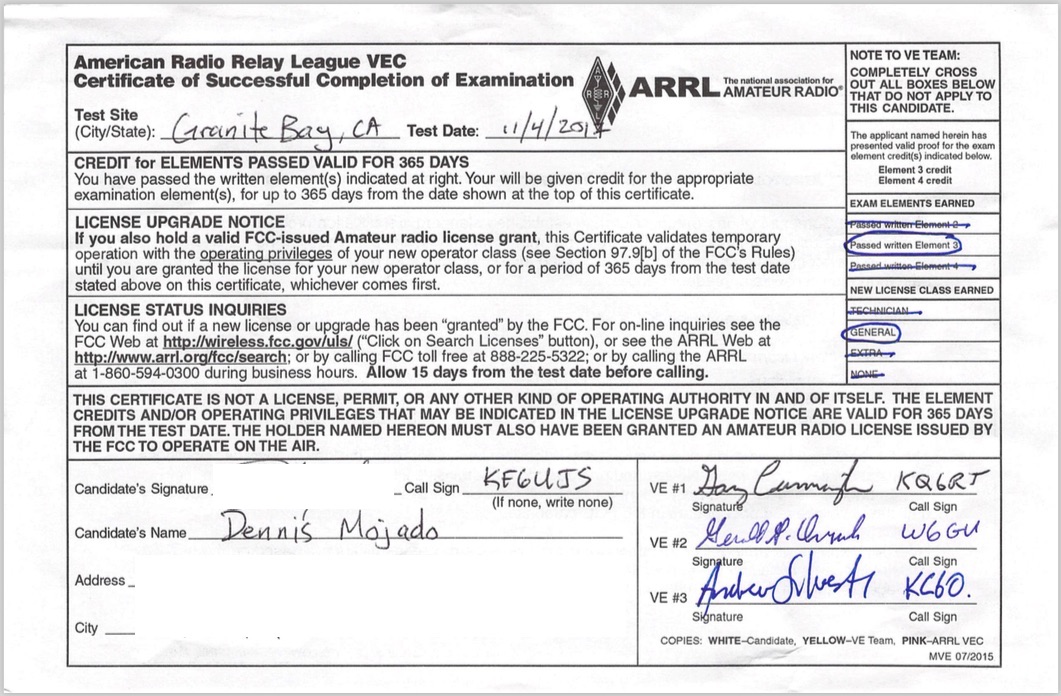
Passed the General License exam this morning in Granite Bay, California.
Not that you can't find my address, but I remove it out of habit.
I’d been studying for about a month. But last night I thought to cram for it since there was an available exam going on in the morning about 50 miles north of me. I went through the whole General Exam question pool. I was unsure of so many answers, and not even halfway through all questions, that I thought, “I’m never going to pass this thing.” There’s a bit of math and frequency allocation memorization needed, as well as understanding schematic diagrams and figuring out ohms, picofarads, and millihenries. But I did power through the studying, referring often back to the reference material. For those interested in studying for any class license, I totally recommend the ARRL series of License Manuals. It’s probably the best way to prep for the exam. Anyhow, waking too early for a Saturday, I got to the exam location by 8:30am and was greeted by WA6FGI Gary, an Amateur Extra VEC examiner. I showed them an official copy of my FCC Technician license and my ID, and got signed in with forms to fill out. I was then given the multiple-choice answer sheet and a test. There were about 6-8 other people there also taking an exam, some totally new to ham radio, attempting to get their Tech. I heard one guy unfortunately not pass for General, and another person not pass, though I’m not sure for what class. Many others got congratulations and a hand-shake from the VEC examiners for getting their license (or upgrade). I got through the exam really quickly, only pausing for 2-3 questions that I was not certain of. When I was done, three Extra class hams looked over my answer sheet and transferred it between each other for triple review. After a few minutes, one of them called me over and congratulated me on passing the General. Another asked, “Would you like to try for the Extra license?” I thought about the prospect of that. Buoyed by the recent victory, I told them, “I studied absolutely nothing regarding the Extra license, but sure! I’ll give it a shot!” They seemed pleased that I would try. I overheard several others who had finished and successfully passed their Technician exams decline the chance to try for the next level. It was a longer test, 50 questions instead of 35 for the General, and significantly harder. I guessed a LOT on this one. After a good long while, I submitted the answer sheet, and several more minutes later, they told me I did not pass for the Extra level. Well, at least I got a taste of what the next exam will be like. Time to hit the next manual and learn! Nevertheless, I’m now an Authorized General class amateur radio operator. KF6UJS/AG. I am so thrilled! HF here I come!
This is probably old hat to the veteran hams out there but this evening I finally, successfully, made clear contact on 10m SSB phone! A milestone for me, after tons of antenna research and tuning around on the frequencies forever. Stockton Delta Amateur Radio Club (SDARC) has a weekly informal net on 28.457 MHz SSB, and whenever I could be at my radio on Thursday evenings, I’ve tried to make contact during this net to no avail. This evening, I decided to move my poorly-placed (6 ft off the ground against a wooden fence) 10m dipole a few feet outward toward the open air, and waited. I should also mention that I utilized the LDG YT-100 auto-tuner for the first time before doing this, ensuring impedance match from my transmitter. WB6NVB/Charlie checked for frequency use then called CQ CQ CQ. I responded to him repeating his call then my call a few times, and lo and behold he got me loud and clear! Over the course of our discussion, he guessed I was putting out 100w. I told him I was starting at 25 watts, and dialed it down to 5, and still was clear. Granted, we are in the same city only several miles apart, so it was sufficient and I continued at that 5 watt power level. So while this was not a DX contact, where I’ve heard 10m has often been a worldwide frequency band, it was exciting for me to finally get a QSO in the HF range. Thanks again, WB6NVB! Soon enough, this will be no big deal to me, but for now it has been a great encouragement in my progress as a ham.
A setback day today, as I finally received a USB audio cable for my attempts to use fldigi with my mac laptop (one of the few SDR programs that works on macOS). I was so looking forward to CQ’ing on my available bands with CW in an automated sense, but no luck. The USB audio cable I ordered (manufactured in Greece, no less), doesn’t seem to work. It is quite frustrating to wait forever for the requisite parts only for me to once again face the world of failure and non-support on Apple Mac computers. The ham software world is very driven by Windows software, something hams really need to change. For the most part, most hams I talk to are using old versions of Windows, and rarely know much about computers– a direct opposite of my life. Had I the desktop software skills, I would totally try to port many of these apps available to the Mac realm. So today has been a setback on several ham fronts: CW was a hard study today, I found the bands empty when searching, and now my foray into digital modes has been halted by technology. But, I am not despairing (too much). Part of being a ham is persistence in the face of a problem. Trying different ways and different configurations until you get the setup right and are able to talk to others.
Spurred by the previous post, I’m using the Koch method for learning Morse code (CW). I’m attaching here a document I made back when I first became a ham in 1999 that is a quick reference for prosigns and Q-Codes. Morse is also there, but I do not recommend CW by sight, has to be reflexive by sound. A good iOS mobile app for this is Ham Morse by AA9PW. Here is my reference document: Ham Code Guide by KF6UJS.