Phone

First QSO on AO-92 Satellite

I received an Arrow II antenna from N9BAV today, a very generous gift after I tweeted that I needed to buy said antenna. After I put it together, I looked on GoSatWatch app to see the next pass of well-known amateur satellites. I immediately recognized that AO-92 was going to pass very well overhead in about 2½ hours. So I prepped my Kenwood TH-D74A with the VHF downlink frequency (145.880MHz) on sub band A, and the UHF uplink (435.340MHz) on sub band B. My previous attempts at satellite with a HT whip antenna and my HVU-8 vertical have met with no success, so I was half expecting this Arrow to also be a failure where I wouldn’t get in. Much to my surprise, the RX side started quieting, and I was hearing solid full-quieting voices! I tried popping in my callsign and no one answered, I had doubled. Then I tried again and WB7VUF came back to me crystal clear. AWESOME. I finished that QSO, trembling with excitement and rambling a bit that this was my first satellite contact, then right after he closed KB6LTY called for me. TWO AO-92 contacts! One thing I learned is the TH-D74A, while having a very convenient recording feature, only records one of the two bands. Luckily I had it preset to sub band A, because I totally forgot about that. So I didn’t record myself, but only the RX. I need to learn how to program the different satellites into memories.

The Other Side of SOTA: Failed Chasing

In today’s episode, I go on my typical Lunch Time on the Air™ (LTOTA) during my lunch hour at work in Rancho Cordova, and I fail at chasing two of my friends activating Summits on the Air (SOTA): - Jose K6HZR activating San Juan Hill (1 pt) W6/CT-230 - Scott N0OI activating Bertha Peak (8 pts) W6/CT-103 Heard voices on Jose’s frequency, but couldn’t verify if it was him. Heard lots of chasers answering Scott, but I guess he couldn’t hear me. In any case, it’s great to know fellow ham friends are out and about, and I’ll try to do my part to help them even if I don’t get the chaser points (as is all too regular). What is SOTA?: https://www.sota.org.uk/ What is a Chaser?: https://www.sota.org.uk/Joining-In/Introduction-to-Chasing


How to Create a Multi-Mode XReflector

JerryNet is so named because one bored commute home, KG6HQD Jerry went on his DStar radio and connected to REF012A to see if anyone wanted to talk. This became a regular thing and JerryNet™ was born. Later we started talking about how to include other digital voice modes such as DMR and Fusion. We needed a cross-mode reflector so we ended up on the QuadNet Array on 757A. Someone from JerryNet threw out the idea of setting up our own multi-dv reflector similar to Quadnet’s. When I first heard this idea, I immediately thought it would be an impossibly daunting task. I had impressions of expensive hardware and codec boards and all kinds of crazy Windows applications. But thanks to the documented sharing of helpful hams like N5AMD (who helped start the reflector and website for San Antonio Digital Radio), as well as Quadnet and Kings of Digital, I was able to see that creating something like this was indeed doable. All that research led to a vision of what we wanted, and I drew that out like this:


DStar and YSF/DMR Reflectors are Live

XLX367 reflector is live! Update: February 2019: All three modes DStar, YSF, and DMR are now crosslinked! DStar REF367A (also XRF367A and DCS367A) is up an running. This is a new multi-protocol DStar Digital Voice reflector, running in the cloud. It is available for public use and is tied primarily with JerryNet communications. Also, a Yaesu Fusion YSF room 68798 is running at the same server, and is bridged to DMR Talkgroup 3128459 DMR (here’s how to connect to XLX DMR). Fusion users can talk in this YSF reflector to other Fusion users, and it is cross-linked to DMR as well for wider reach. I am currently working within the Brandmeister support process to tie the XLX reflector to a DMR master, but until then, the reflector works for all 3 ham major digital voice modes. Please visit the reflector on one of your digital voice radios and say hi!


Build Your Own DMR/DStar/Fusion Hotspot for CHEAP

In an effort to get more people on digital ham radio easily, I posted a video about how to put together your own multi-mode digital voice hotspot device very inexpensively, and with little effort. I have put together several of these and the work pretty well. Kind of like an oil change, almost anyone can do it.

https://youtu.be/LspgnvDPJvc

I admit, I used to have a purist mindset about ham radio. All these Internet-dependent modes such as Echolink, IRLP, and even analog repeater inter-linking over the Internet had me thinking “but what happens when the grid goes down?” I’ve experienced some pretty bad fails as a systems & software engineer, and also as a site reliability person constantly on-call, so I’ve come to expect that even on the best of days, parts of the Internet like to fail spontaneously and without provocation.


Test Ed Fong Roll-up J-Pole

One of the few things I actually took home from Pacificon 2018 in San Ramon was an Ed Fong “DBJ-2” Dual-band Roll-up J-Pole for 2m/440. A vendor was asking me if I needed a cool base-station 2m antenna (DBJ-1), and I said I already had one set up. I recognized the seller’s nametag and said, “But I do know your name… Do you happen to have any of your famous Roll-up J-pole antennas?” He had only a couple more. I knew about this antenna from SOTA YouTubers KG6HQD Jerry and W6RIP Kevin, and wanted to try one since seeing Jerry throw one over a tree and blanket the whole Los Angeles basin with his VHF reach. In this video below, I demo hitting a repeater 45 miles away on 0.05w (50 milliwatts). No one gave me a signal report on that attempt, but I was able to get someone to confirm readability on another repeater 20 miles away on 0.05w, and “much clearer” on 1w. https://youtu.be/sW40nKJk1qo So when you hear people with stock antennas on Baofengs complaining they cannot hit repeaters with their “HP” 8 watts, think about the antenna and its location, not on getting an amp or higher power mobile rig.


Got my first QSL card!

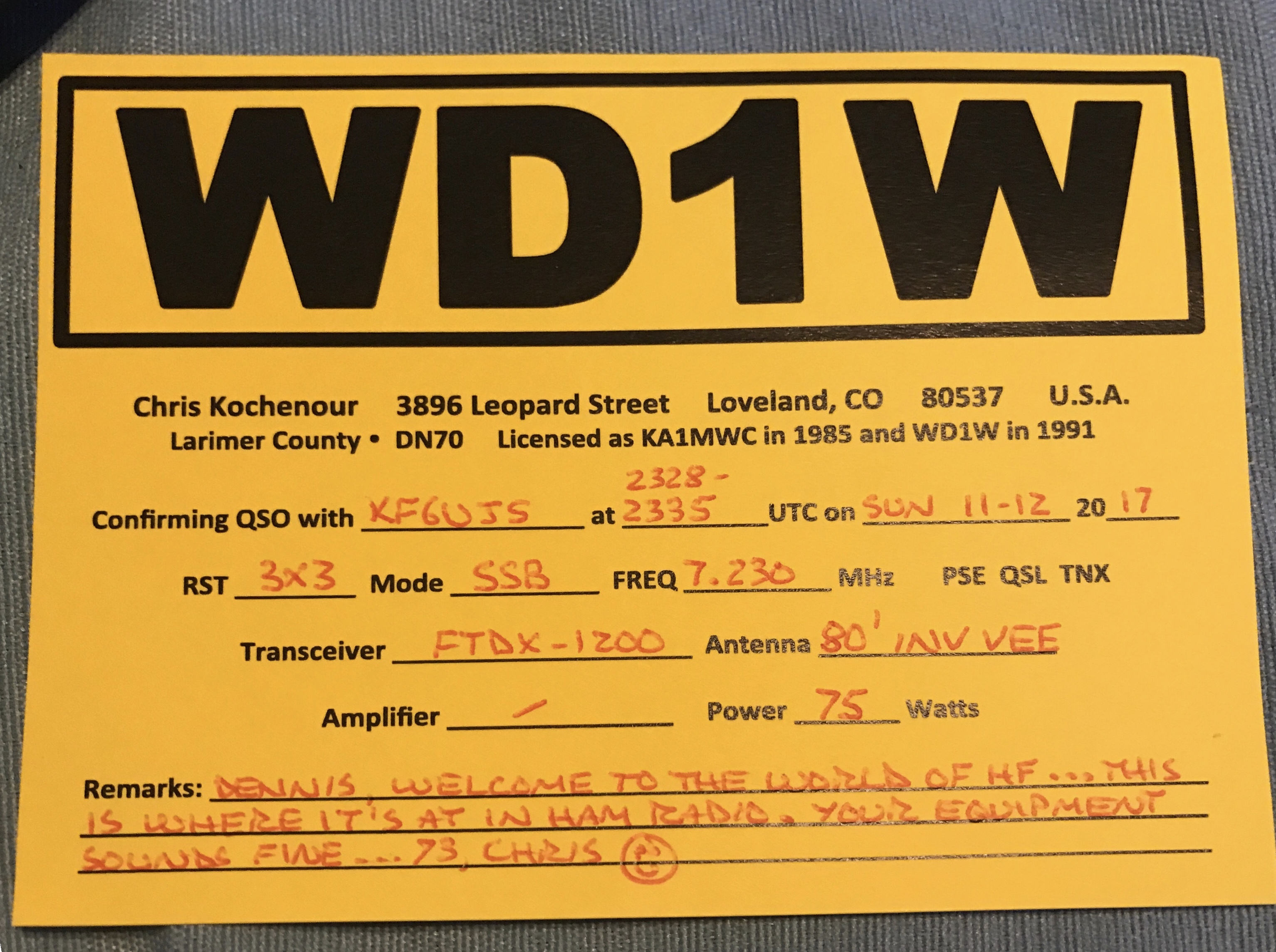
Whoa. Unexpected but received my first QSL card in the mail today from my 2nd ever (and farthest so far) interstate contact: WD1W in Colorado.

QSL card from WD1W Chris in Colorado.

What a great ham tradition. I gotta get me some QSL cards made up to send to people.


First HF QSOs! ID, CO, and SoCal

This afternoon I went to my brother-in-law’s property about 8 miles from my house, where he has nice wide open lot, and I set up my N9SAB 40m-6m off-center fed dipole with a portable flagpole (20ft high). I figured the open space would do some good for the signal. I set up with an inverted V configuration, had my FT-857D with YT-100 tuner and 7ah battery, and even unfolded the 39w solar panel to help the battery.


First Reception of International Traffic

I deployed my 40-6m OCF dipole in my back yard here in Stockton, CA (grid CM98hb), and tuned on 20m on Saturday afternoon, and for the first time on this band found a clear QSO in progress. https://youtu.be/PJB4J9hA0J8 W3BQG was transmitting initially with 1000w from near Pittsburgh, PA, and his CQ was answered by someone in Japan, whom I could also hear. He says he later bumped it down to 500w. A lot of the time on simplex conversations like this, it’s one-sided with only the nearer person audible, but this was an easy QSO to follow. I suspect the Japanese operator was sending high wattage as well. This was almost 3pm PDT, so that would have been close to 7am in Japan. 20m is amazing during the day. I wish I could get my antenna real high so I could start trying to contact the busy DX bands. I did try later, calling CQ from KF6UJS/AG, but no one could hear me. I’ll keep trying!


First 10 Meter QSO!

This is probably old hat to the veteran hams out there but this evening I finally, successfully, made clear contact on 10m SSB phone! A milestone for me, after tons of antenna research and tuning around on the frequencies forever. Stockton Delta Amateur Radio Club (SDARC) has a weekly informal net on 28.457 MHz SSB, and whenever I could be at my radio on Thursday evenings, I’ve tried to make contact during this net to no avail. This evening, I decided to move my poorly-placed (6 ft off the ground against a wooden fence) 10m dipole a few feet outward toward the open air, and waited. I should also mention that I utilized the LDG YT-100 auto-tuner for the first time before doing this, ensuring impedance match from my transmitter. WB6NVB/Charlie checked for frequency use then called CQ CQ CQ. I responded to him repeating his call then my call a few times, and lo and behold he got me loud and clear! Over the course of our discussion, he guessed I was putting out 100w. I told him I was starting at 25 watts, and dialed it down to 5, and still was clear. Granted, we are in the same city only several miles apart, so it was sufficient and I continued at that 5 watt power level. So while this was not a DX contact, where I’ve heard 10m has often been a worldwide frequency band, it was exciting for me to finally get a QSO in the HF range. Thanks again, WB6NVB! Soon enough, this will be no big deal to me, but for now it has been a great encouragement in my progress as a ham.