Dan AI6XG has been doing SOTA for a couple years, and we were in CWOps Level 2 class together in 2018. He graciously offered to go on a SOTA hike with me, and picked this great spot mapped out by Jeff AA6XA around the Lake Berryessa area. Enjoy watching my struggle as I get into this new facet of ham radio. https://www.youtube.com/watch?v=bkUUWyhsI4k
It was a very short hike, but steep. On Dec 8, I hiked with Rex KE6MT up to Point 1272, a.k.a. SOTA peak W6/NC-387. Rex is the W6 Association Manager for SOTA. Here is a video of the trip. https://youtu.be/0puPiyyyN3M
JerryNet is so named because one bored commute home, KG6HQD Jerry went on his DStar radio and connected to REF012A to see if anyone wanted to talk. This became a regular thing and JerryNet™ was born. Later we started talking about how to include other digital voice modes such as DMR and Fusion. We needed a cross-mode reflector so we ended up on the QuadNet Array on 757A. Someone from JerryNet threw out the idea of setting up our own multi-dv reflector similar to Quadnet’s. When I first heard this idea, I immediately thought it would be an impossibly daunting task. I had impressions of expensive hardware and codec boards and all kinds of crazy Windows applications. But thanks to the documented sharing of helpful hams like N5AMD (who helped start the reflector and website for San Antonio Digital Radio), as well as Quadnet and Kings of Digital, I was able to see that creating something like this was indeed doable. All that research led to a vision of what we wanted, and I drew that out like this:
This past year was an eventful ham radio one. As I begin to look ahead to goals and daydreams of 2019, it’s always good to not expect the past to be the norm, but to take a moment and appreciate all the stuff that’s happened good and bad.
Thinking back, it’s amazing when I consider HF newbie AD6DM 2017 vs. AD6DM 2018. Here are some of the things I experienced in 2018:
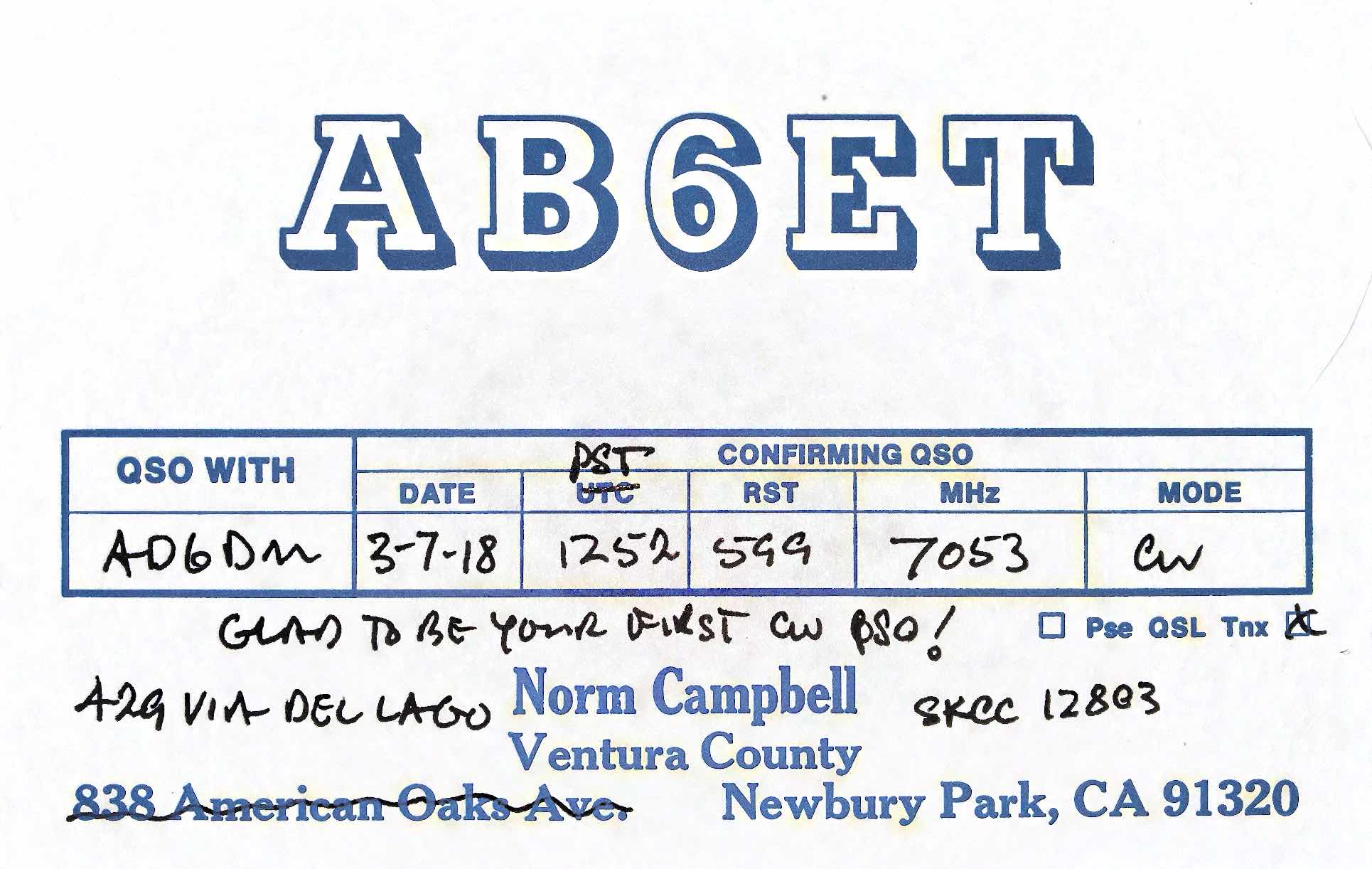
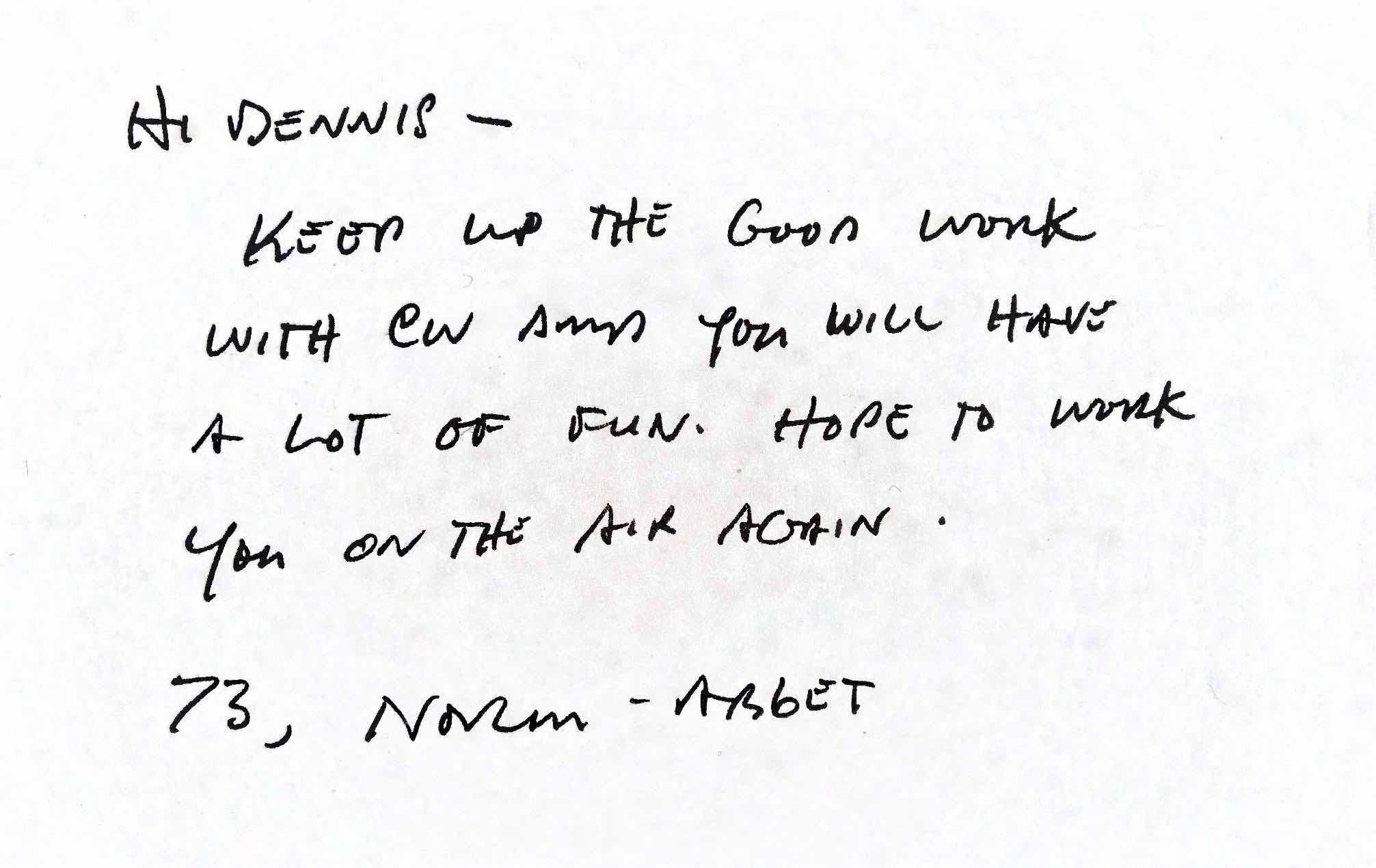
Today I received my first reply QSL card. And for a CW QSO, no less!
AB6ET QSL Card sent in response to the one I sent him. Thanks, Norm!Back of AB6ET QSL Card
On March 7, 2018, during my lunch break I set up my mobile 40m hamstick in the office parking lot and surfed around the CW frequencies of 40m (i.e. 7.000 to 7.125 MHz). It was mostly me calling CQ and with no replies, but toward the end of the lunch hour, I heard someone coming in pretty loud, and slow enough that I could (mostly) make out the characters. By the second callsign send, I could visualize: AB6ET. I hoped I was getting it right. When AB6ET finished, I sent out, “AB6ET DE AD6DM AD6DM K”. Expecting to hear the CQ call again (which is normally the case, nearly no one hears me), I prepared to shut down and go back to work. But then AB6ET was sending my callsign! WOOHOO, I had just made a CW contact! The QSO was horrible, and by no fault of AB6ET. I sent “SRY MY CW IS BAD, NEW TO CW” (or at least I tried to send that), as well as totally mucking up his RST report and other words. I felt so unprepared. I didn’t have a pencil or paper, and when I thought I could rely on the CW translator of the radio, it totally failed me due to the background noise. I copied perhaps 25% of what he sent, but I did make out NORM as the name, and bits and pieces. It was an embarrassing conversation due to my limitations. Later that evening I found Norm’s email on QRZ.com, and asked him if I got the callsign right. The next day he replied that yes, we indeed talked on CW, and he encouraged me to keep it up and gave a lot of great tips on how to get better at CW. I felt very motivated to keep at the CW practice after that email. This contact was 300+ miles away on 40m, transmitting roughly 10 watts into a mobile 8ft vertical hamstick with about 2.2:1 SWR. Not bad for a lunch break, I’d say!
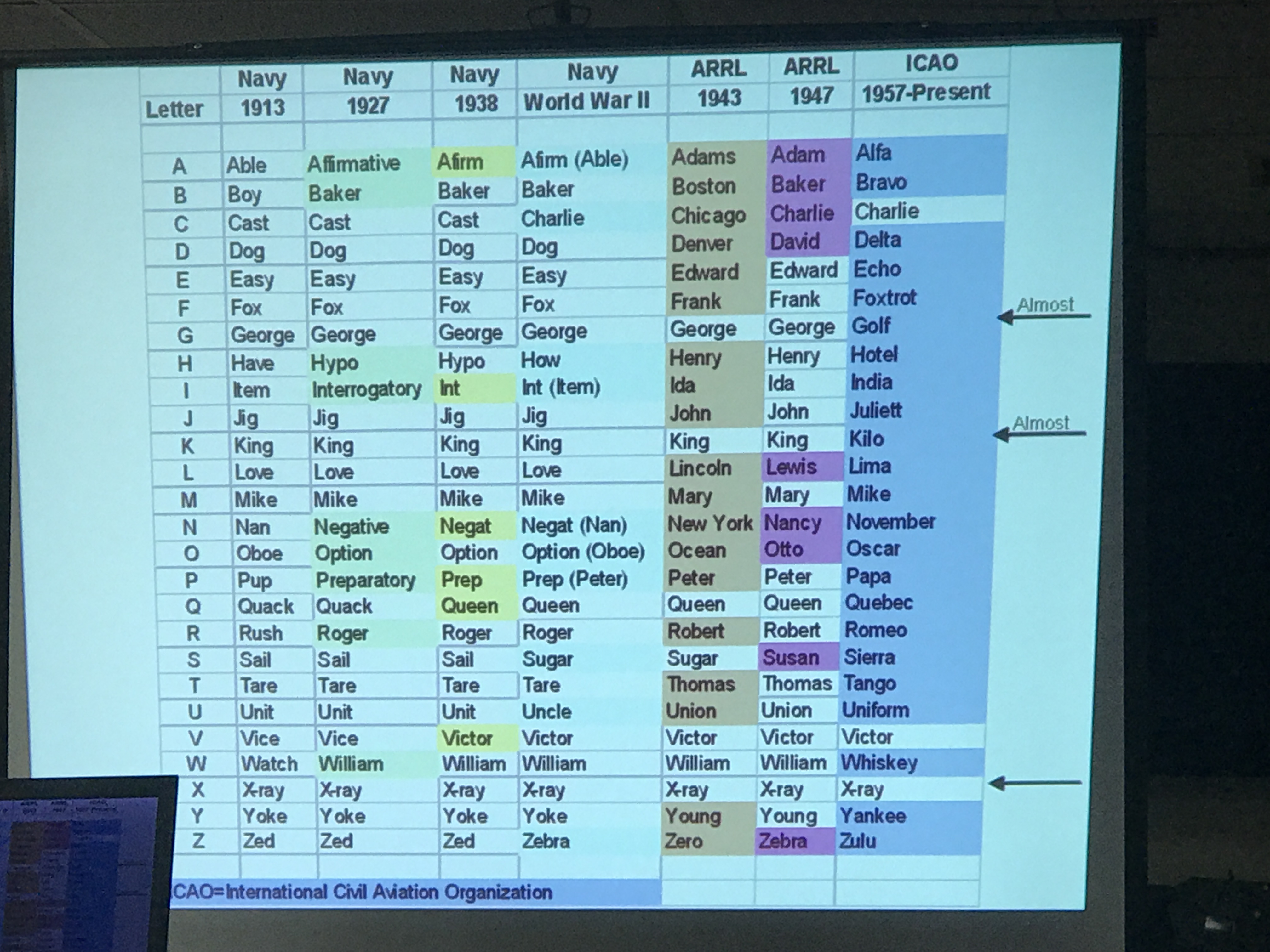
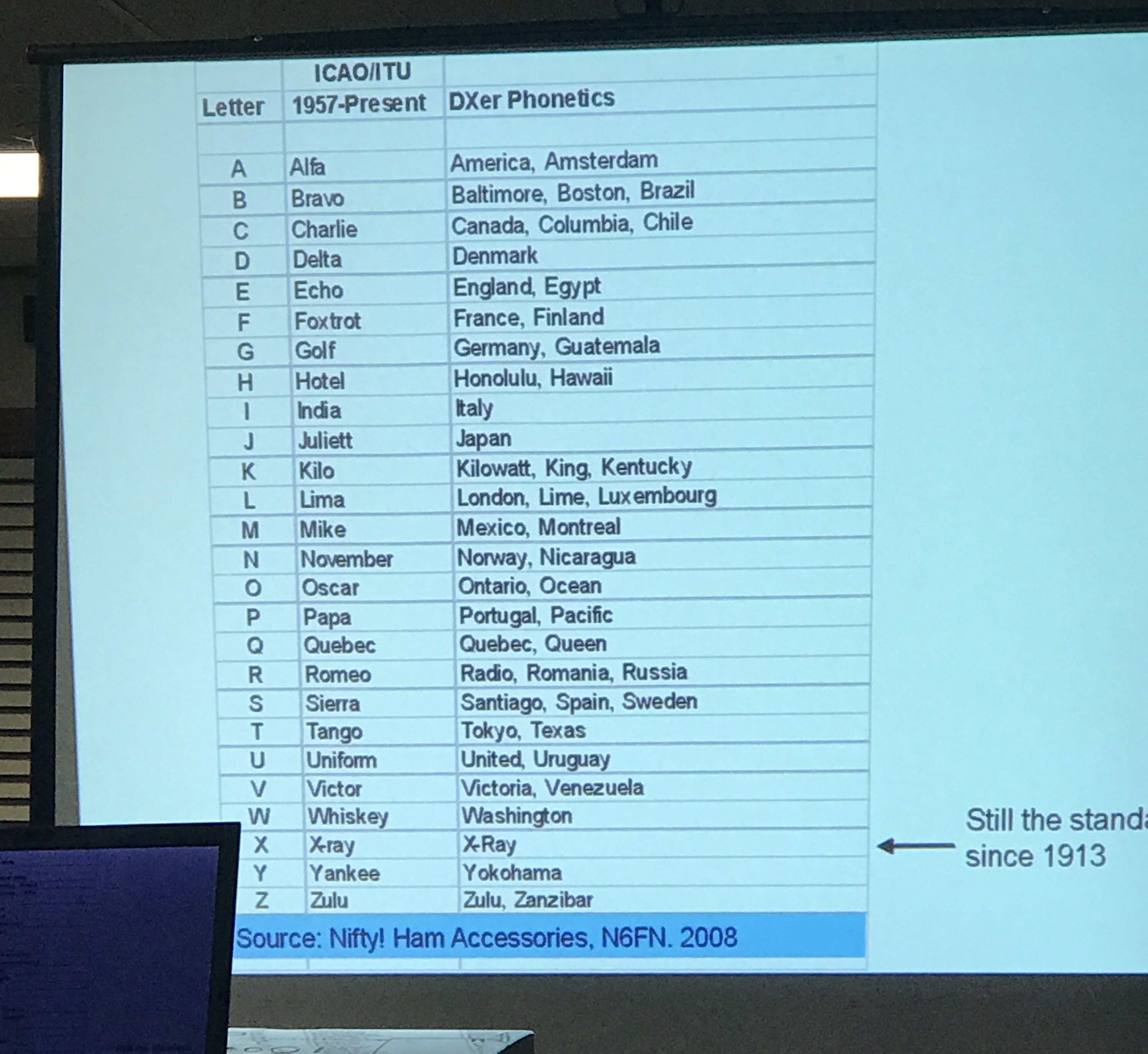
We had our monthly meeting for the Stockton Delta Amateur Radio Club on February 8, 2018 at 7:30pm. After usual club announcement and business, we were treated to a presentation by Jim WB6BET of the Lodi Amateur Radio Club (LARC): The History of Phonetics.
Phonetics in America from 1913 to present
Jim went on to describe DX phonetics.
Alternative phonetics for DX, easier to read at times.
Emilia KI6YYT, president of LARC, also gave a presentation on the USS Hornet, describing its radio systems and an all-women’s QSO event they held there last year. It was interesting to see the kinds of radios they used on ships back then (one slide had a bank of Harris RF-350s). It’s cool that the club meetings are not only a chance to place faces with callsigns, but that each one has some educational aspect in mind. SDARC really has a goal of helping the ham community learn more and make an impact.
Today marks the day I took the final for ARRL’s EC-001: Emergency Communications Basic/Level 1 course. It’s a 9 week course that I started in November and covers a wide range of EMCOMM topics: From the organizational structure of emergency communicator groups to traffic net etiquette to digital modes to message handling to deployment preparation and expectations. It is designed for those who want to volunteer in ARES or another emergency communications group.