SSB

Some Number Stations Sunday Morning

This morning I thought I’d search for number stations on the bands. According to Priyom.com,

Number stations are shortwave transmissions from foreign intelligence agencies to spies in the field of foreign countries. They carry encrypted messages in form of groups of numbers or letters, using either automated voice, Morse code, or a digital mode.

Here are a few number stations I heard this morning thanks to Priyom.com’s schedule: M12 station (Moscow) on 13.379MHz in morse code at 16:40 UTC. For those who don’t know CW, it is repeating “931” over and over with occasional breaks of “TTT” which Priyom says means “000”.   E11 station (Warsaw) on 12.229MHz in upper sideband mode at 16:50 UTC: “niner two niner oblique zero zero”.   HM01 station (Cuba) on 11.530 in AM mode at 16:58 UTC (schedule said 17:00 UTC), groups of numbers in spanish.   E07 station (a.k.a. “The English Man”, Moscow) on 12.223MHz in upper sideband mode at 17:00 UTC, “two zero one”.   It was very interesting listening live to these mysterious stations. Worldwide passive transmissions like these make you wonder what’s going on out there on the airwaves.


The Other Side of SOTA: Failed Chasing

In today’s episode, I go on my typical Lunch Time on the Air™ (LTOTA) during my lunch hour at work in Rancho Cordova, and I fail at chasing two of my friends activating Summits on the Air (SOTA): - Jose K6HZR activating San Juan Hill (1 pt) W6/CT-230 - Scott N0OI activating Bertha Peak (8 pts) W6/CT-103 Heard voices on Jose’s frequency, but couldn’t verify if it was him. Heard lots of chasers answering Scott, but I guess he couldn’t hear me. In any case, it’s great to know fellow ham friends are out and about, and I’ll try to do my part to help them even if I don’t get the chaser points (as is all too regular). What is SOTA?: https://www.sota.org.uk/ What is a Chaser?: https://www.sota.org.uk/Joining-In/Introduction-to-Chasing


80m RTTY

I found a load of RTTY on 80m band on Sunday night (1/7/2018). I tuned to 3580 kHz and found a particularly strong signal, so I hooked up my USB soundcard to my laptop, fired up fldigi and made attempts to reply, but I guess my QRP setup didn’t get heard in all the pileup chatter. Turns out, January 6-7 was “ARRL RTTY Roundup”, a nationwide contest to make contacts in the digital format, so it was easy to catch the conversations on almost all HF bands. I found the CQ’s in this format a bit odd, and didn’t really know how to format my responses or how to call CQ myself. I saw things like: TEST N6JJ N6JJ CQ (not real callsign), or CQ RU N6JK CQ. What? I went with the way I new how to call CQ, which was: CQ CQ DE AD6DM PSE K. (meaning: Calling any station from AD6DM please reply). No replies. There were a lot of transmissions like: W7KJ N6JK 599 5NN TU 73. I took these to mean an acknowledgement, a signal report, thank you, best regards. RTTY is a very quick format. It’s like a drive-by greeting that is over before you know it. It’s probably how hams did contest contact-gathering before the more modern semi-automated FT8 format. In any case, I want to get out there on RTTY and give it more of a try.


What is this transmission?

I checked in to W6VVR Vaca Valley Radio Club net this evening and they said post-net they’d be hopping on to 7.190MHz. Quickly set up my bugcatcher for 40m and listened, but nothing heard, except for a QSO in progress on 7.192 from Arizona to Los Angeles. So I thought I’d tune around on the new Extra sections of 7.075-7.100MHz (Hawaii and Alaska can use this for voice, but we mainlanders can’t.) Was expecting CW and perhaps some blurty digital sounds. Instead I found this: https://youtu.be/mvkWdpZFwPQ What is this? I imagine it’s a digital mode (somewhat like Olivia) but I’ve never heard anything like it. Makes me think of a harmonic alien transmission.


Got my first QSL card!

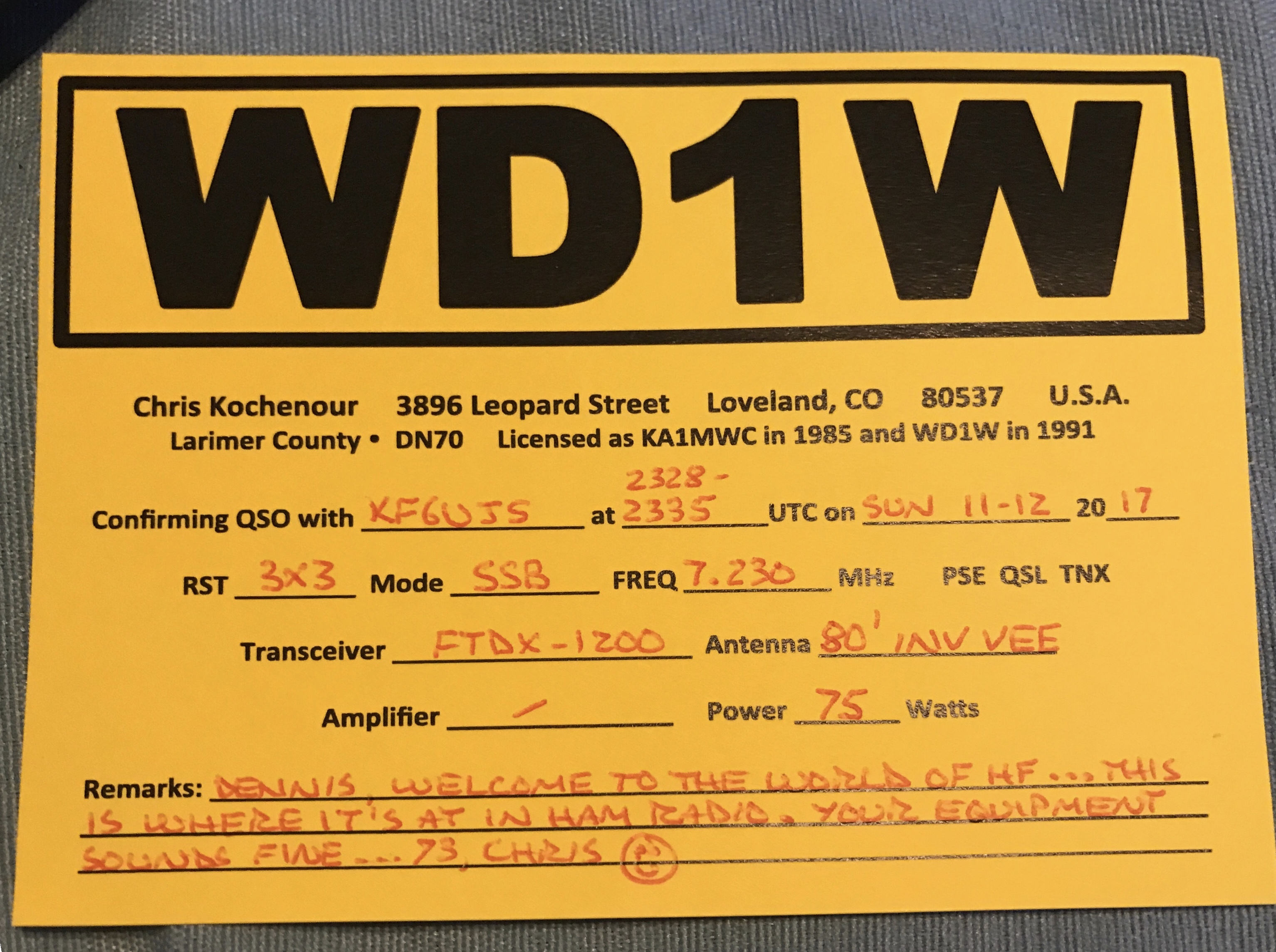
Whoa. Unexpected but received my first QSL card in the mail today from my 2nd ever (and farthest so far) interstate contact: WD1W in Colorado.

QSL card from WD1W Chris in Colorado.

What a great ham tradition. I gotta get me some QSL cards made up to send to people.


First HF QSOs! ID, CO, and SoCal

This afternoon I went to my brother-in-law’s property about 8 miles from my house, where he has nice wide open lot, and I set up my N9SAB 40m-6m off-center fed dipole with a portable flagpole (20ft high). I figured the open space would do some good for the signal. I set up with an inverted V configuration, had my FT-857D with YT-100 tuner and 7ah battery, and even unfolded the 39w solar panel to help the battery.


First 10 Meter QSO!

This is probably old hat to the veteran hams out there but this evening I finally, successfully, made clear contact on 10m SSB phone! A milestone for me, after tons of antenna research and tuning around on the frequencies forever. Stockton Delta Amateur Radio Club (SDARC) has a weekly informal net on 28.457 MHz SSB, and whenever I could be at my radio on Thursday evenings, I’ve tried to make contact during this net to no avail. This evening, I decided to move my poorly-placed (6 ft off the ground against a wooden fence) 10m dipole a few feet outward toward the open air, and waited. I should also mention that I utilized the LDG YT-100 auto-tuner for the first time before doing this, ensuring impedance match from my transmitter. WB6NVB/Charlie checked for frequency use then called CQ CQ CQ. I responded to him repeating his call then my call a few times, and lo and behold he got me loud and clear! Over the course of our discussion, he guessed I was putting out 100w. I told him I was starting at 25 watts, and dialed it down to 5, and still was clear. Granted, we are in the same city only several miles apart, so it was sufficient and I continued at that 5 watt power level. So while this was not a DX contact, where I’ve heard 10m has often been a worldwide frequency band, it was exciting for me to finally get a QSO in the HF range. Thanks again, WB6NVB! Soon enough, this will be no big deal to me, but for now it has been a great encouragement in my progress as a ham.


Found a Beacon on 2m

I briefly heard someone on 10m single-sideband (SSB) saying goodbye to his QSO friend, and that he was going to tune around on 2m SSB. Although I knew 2m SSB existed, never occurred to me that now that I have an all-mode rig, I could also tune around there instead of being bound only to FM by a handheld radio. I started sweeping from 144.100 MHz and started hearing morse code at right around 144.282 MHz. I switched to CW mode and tuned further to 144.282.23: https://youtu.be/tsUv91BxZxQ I recorded it, and was fascinated. Note, this was received while connected to my 10m dipole antenna that is pretty poorly mounted against a fence 6ft off the ground– not the most optimal setup. After spending many retries, replaying the recording over and over and referencing my morse code (CW) cheatsheet, I found this to say: