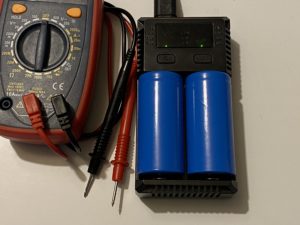
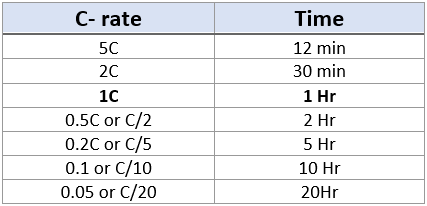
 Those who jargon in the battery building community are familiar with the “C” rate of batteries they buy or build. But what is C, and why should you care? This article hopes to discharge some knowledge on the topic at a high C rate. We are all familiar with amp-hours (amps times hours), watts (volts times amps), and watt hours (watts times hours). But if you discharge a 6Ah battery at 6A, do we just say “at a rate of 6A for one hour”? We have a shorter way to say that: 1C current. 1C is the rate at which it takes to drain a battery in 60 minutes. An unofficial standard among batteries, especially Lithium Iron Phosphate batteries, is to have a maximum continuous discharge rate of 1C, peak momentary discharge of 3C, and an ideal (optimal) discharge rate of 0.2C. Moreover, it is often normal manufacturer specification to charge a battery at a max of 0.5C, or half its capacity in amps current.
 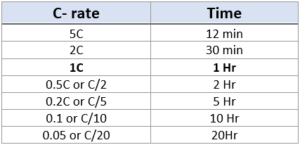 So a 6Ah battery discharged at 1C will provide 6 amps for 1 hour. At 0.5C it is drained at 3A in 2 hours. At 3C it is drained at 18A in 20 minutes (1/3rd of an hour). At 0.2C this battery is drained (optimally) at 1.2A for 5 hours, and charged at a rate of 3A maximum current. The battery C rating is the measurement of current at which a battery is charged and discharged. But this is in ideal situations. The truth is, batteries don’t like being discharged at a high rate, hence some discussions and notices you read that talk about optimal discharge rate vs. max discharge rate. The higher you go, the more energy is lost in heat, inefficiency of connections, and overall degradation of performance of the battery internal ion transfer. Running a battery at its max C rate for will generally produce runtimes shorter than the C rate calculation. So if I take my 6Ah battery again as an example, if I run it at 18A, I will probably get more like 15 minutes out of it instead of the full 20 minutes.
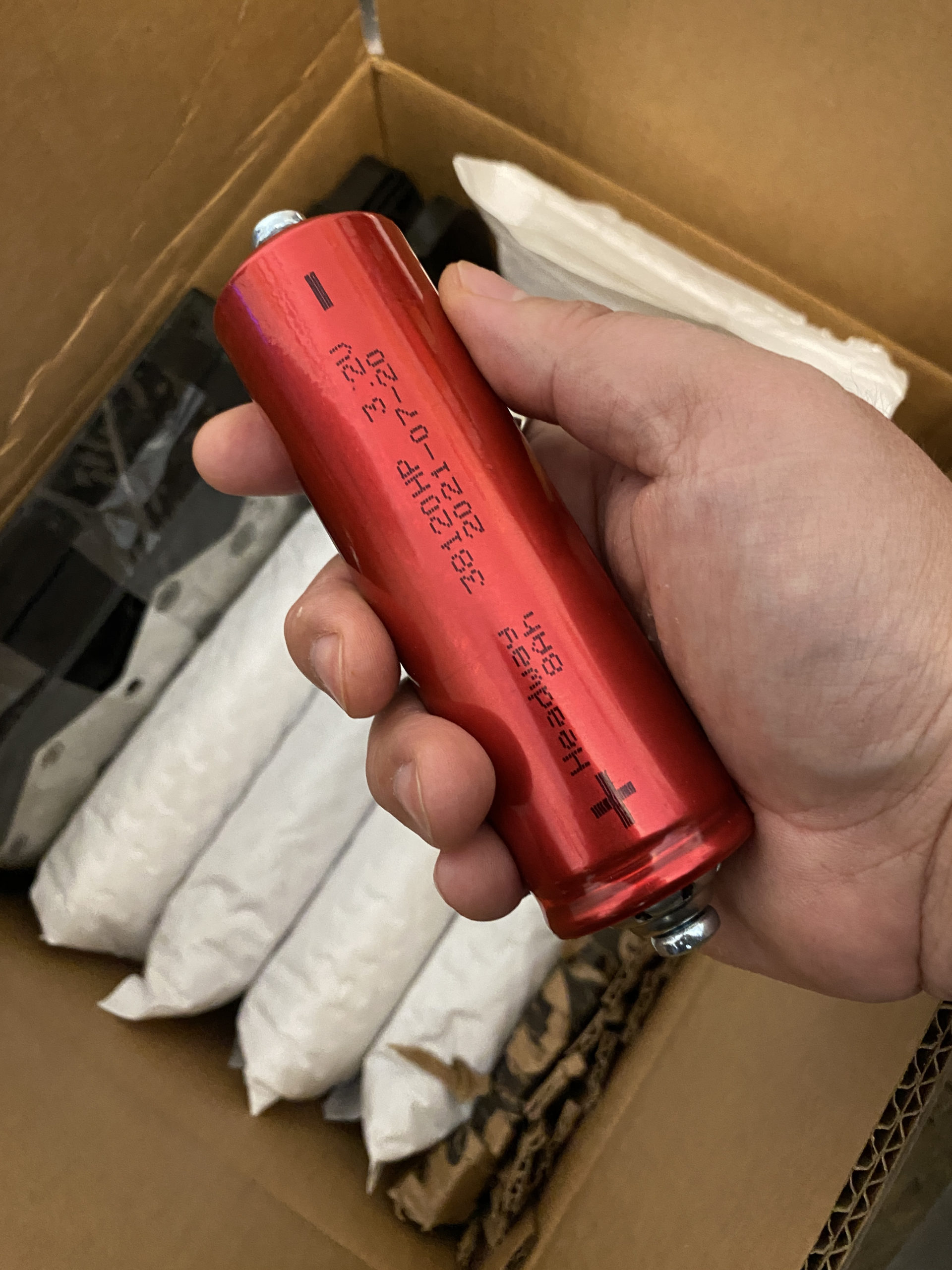
 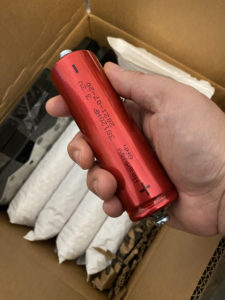 Many battery performance graphs show you drain tests of 0.1 to 0.2C as the reference discharge current, to allow the battery to sustain its performance as long as possible. Some high-performance batteries are specifically designed to produce shorter high C discharge and charge rates. These batteries are designed for large amps and sustained bursts, and often cost a lot more than you’d expect for comparative amp-hours. A great example of a high-performance battery is the Headway cell. The 38120 version is rated at 8Ah, but can deliver a continuous 120A (15C) and charge at 80A (10C). High performance cells tend to be large(r) and have bulkier connection gear to handle the current demands. But stable high C rates are not what you will typically find in deep cycle or solar storage batteries that ham radio operators like to use. So how do you increase the amp throughput without spending more than you should for “high performance”? Get a bigger battery (more capacity). The C rate follows the overall capacity of a battery, so a 6Ah is best discharged at QRP radio levels of 1.2A (0.2C), while a 100Ah battery would not be stressed by continuous 20A of a portable QRO rig (again, 0.2C). This guideline starts to break down beyond 100Ah battery capacities, as many consumer deep cycle batteries limit at 100A current with peak to 200A. So a 200Ah or 300Ah may still only max discharge at 0.5C or 0.33C, respectively. That’s a lot of amps, and components get unwieldy at currents larger than that. Many people think 3Ah to 4.5Ah for a QRP radio is good, and in most cases it is, just don’t always crank it up to 10W transmit. And for a QRO radio run at full power, most tend to think the highly portable 12Ah to 20Ah 12V battery is perfect. But if you read the specs, you might actually be over-taxing your battery’s recommended C ratings, lessening its cycle life. Transmitting at 100W portable comes at a cost. This is also why building your own batteries to match your C requirements is both fun and challenging. Finding cells, BMS’s, and connecting components to match your desired amps requires careful design and balance.
  The good news is that as long as your cable gauges and terminal connections are correct for the current, you won’t experience as bad a Peukert’s Effect on consumer or DIY LiFePO4 batteries like you would with lead-acid or AGM batteries (i.e. the significant drop in voltage and capacity when high current is drawn). Lithium chemistries give a lot and draw a lot. This is also why it’s important to have a good BMS and stay within its limits. If you connected to raw series cells of a LiFePO4, you could send or charge hundreds of amps very easily, and needs a limiting mechanism to prevent damage to the cells. Many users of modern batteries just unbox them and plug them in without a second thought. It is helpful and important for the life of your battery to read the specifications and understand good charge rates, discharge rates, and keep things within nominal parameters. When you mind these characteristics, you will have a battery that will last you many years.

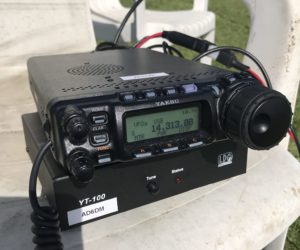 One of the things a new General class ham will find about new HF radios is there’s very little in the way of explaining how to power the more advanced rig. All you get is a funky Molex connector and a pair of bare wires with fuses on them. When I got my first HF rig, a Yaesu FT-857D, I was perplexed that I couldn’t just plug it in to the wall AC outlet. Many manufacturers do this because they do not know how you will install your new radio. Mobile ones like the 857D I had are intended to be wired to the 12V electrical system of a vehicle. Larger desktop HF radios also use 12V, but the manufacturer does not assume how you’re supplying that 12V or what type of power connector you’ll be using, so they just give you a long pair of black and red wires. Naturally, a new ham will want to either buy a 12V battery, or a 12V power supply. And not knowing any better, what are the 12V batteries we find everywhere? Car batteries. Sealed lead-acid (SLA) heavy batteries that power everything from motorcycles to boats.
 Getting into amateur radio these days is much like merging onto a freeway. If you hesitate in the on-ramp you might just pull over to the shoulder and watch all the traffic speed by while you sit there indecisively. But taking the metaphor further, you need to even select your vehicle first, and that is often the hardest part. I say vehicle because while one might think “car” the choices might also be motorcycle, trike, go-kart (illegal on freeways), or bicycle (also illegal, and has an entirely different, though parallel purpose). Selecting your first ham radio is hard especially because a new person doesn’t quite know what to do with one. Other online Elmer hams would ask “what do you want to do?” but often the answer is “I don’t know yet.” I would suggest that if you’re new to the hobby or thinking about starting, get the most versatile rig you can afford. If your budget doesn’t allow the latest souped-up awesomeness available on the market, look for most features for the money in the used market or the Chinese market. If you get serious about it, inevitably you will supplement your tools with more rigs; but for now try not to go ultimate cheap limited-function just to “try it out”. You will find the difficulty in doing what you want to try, especially if you don’t know what you want yet, might get you quickly discouraged and bored. In the corporate and/or creative world, starting out means high enthusiasm, low competency. Eventually you want to get to high enthusiasm, high competency. (Some say after a long while you get to low enthusiasm, high competency, and just become a paycheck collector.) With that in mind, you don’t want your new tools to get in the way. If there is so much to learn, and barriers along the way due to your rig, you can simply lose motivation. Reserve the specialty kits, the QRP rigs, the budget single-function items to later exploration once you’ve found your path in this 60,000 sub-hobby hobby of ours. Start off opening up your options. With that said, what are good starter rigs? Here are a few that come to mind (along with their prices at time of writing):
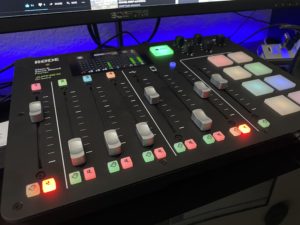 This is a bit of overkill just to have clean PC audio to speakers, but I liked the idea of it and was just moved to get it. After folks saw it, they asked me “when will your podcast be out”. You see, this device is intended for podcasting primarily, and perhaps streaming secondarily. It’s not meant to just be a USB audio out, which was my original intention. So I got to thinkin’… what could I podcast about. For about a month after having this, I still had no ideas, but I did play a lot with the features in web conferences like using the sound effects, recording different sounds sources, and using it with streaming. In the end, I thought, why not, let’s try a ham radio podcast. That night, toward the end of July, a thought popped in my head before going to sleep: I should call it Hamdom Thoughts. I used to have a blog long time ago called Random Thoughts, and I wanted to talk about what was going on in all of hamdom. I bet no one gets it, but why not. The next morning I signed up on anchor.fm and began the process of recording a quick intro trailer to get the distribution set up. It took about a week, but all major platforms were reporting search availability for